
Serum vs. Lyophilization Vial Stoppers: What Actually Matters When You Buy
A vial stopper is not a lid. It is a compounded rubber formulation, engineered to defined dimensions, qualified against pharmacopeial chapters, and supplied in one of several cleanliness states — each of which shifts a specific validation burden between your supplier and you.
If you have ever been handed a stopper specification sheet and asked to confirm it is "the right one," here is what to check, in the order it matters.
Everything starts with one question: liquid or freeze-dried?
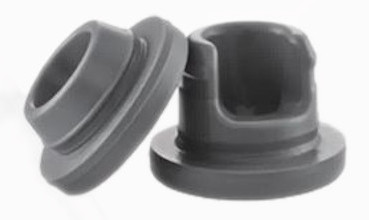
Serum stoppers have a solid plug and form two seals the moment they are inserted: a land seal between the flange (the wide disc on top) and the vial's sealing surface, and a plug seal between the plug's outer wall and the vial neck. The aluminum crimp holds that compression for the product's shelf life.
Lyophilization stoppers have vent channels cut into the plug. They sit in a partially inserted "half-stoppered" position through freezing and drying so water vapor can escape, then get pushed fully into the vial by the lyophilizer shelf at the end of the cycle — inside the sterile chamber, after nitrogen backfill.
Every other design difference follows from that one requirement.
The sizing mistake almost everyone makes once:
A "13 mm stopper" and a "20 mm stopper" are named for the vial neck finish, not the vial's volume. The way you determine is: If the vial has a 7mm hole opening, it requires a 13mm stopper (outside rim diameter); whereas a 13mm hole opening requires a 20mm stopper (outside rim diameter). THE OUTSIDE RIM DIAMETER MAKES THE DECISION. Under ISO 8362-1, the 13 mm neck finish and 20mm neck finish is outlined, but not all vials are ISO dimensions! On the IVPACKS website, all 2ml and 3ml vials require a 13mm stopper, while SOME of our 5ml, 6ml and 10ml vials can use either a 13mm or a 20mm stopper, so it is important to contact us in advance to be sure. All of the IVPACKS vials from 15ml to 200ml require a 20mm stopper. ALWAYS confirm the neck finish from the vial drawing; never infer it from volume of the vial.
Straight plug or blowback?
A straight plug serum stopper has smooth, essentially parallel plug sidewalls. It seals through interference fit and the compression the crimp maintains, and is fully capable of maintaining container closure integrity when dimensions and compression are correct.
Blowback is the feature most often described incorrectly, so it is worth getting right: the blowback is a bead or groove formed in the vial neck, not on the stopper. European blowback (EBB) is an internal bead at the crown finish; American blowback (ABB) is an indentation just below it; non-blowback (NBB) necks have neither. Stoppers are made in families whose plug geometry engages the matching vial neck feature.
Blowback exists because vials coming hot off a depyrogenation tunnel and filled with liquid trapped expanding headspace gas that pushed stoppers back out. So blowback is a retention feature — it resists pop-off. Published work states directly that blowback designs were developed to address pop-off rather than integrity, and that integrity is achievable on non-blowback necks given correct dimensions and compression.
That is still a real advantage — just a different one from sterility assurance. Since all three neck types remain in circulation, specify the stopper and the vial as a matched system.
Two-leg, three-leg, or igloo — and the claim to discount
Two-leg closures split the plug into two opposing legs. The symmetric geometry sits level in the half-stoppered position. The main liability is twinning — legs of adjacent stoppers interlocking in a feeder bowl and stopping the line.
Three-leg closures spread contact across three points around the vial bore, intended to improve stability in the vented position — though published comparative data against two-leg designs is scarce.
Igloo (single-vent) closures use a monolithic domed plug with one large opening instead of separate legs. With no independent legs there is nothing to interlock, so twinning drops substantially, and igloos are generally reported to sit more stably in the vented position. The trade-off noted in independent commentary is that the asymmetric geometry can shift vertically during insertion and may need filling-line optimization.
Now the claim to discount. A study in the PDA Journal of Pharmaceutical Science and Technology tested one-leg (igloo), two-leg and three-leg stoppers and found no statistically significant difference in drying rate among the three designs once vent area exceeded roughly 20 mm² — well below the vent area of any commercial lyophilization stopper. The same work found that blocking up to 50% of the vent area had no measurable effect on drying rate.
If a supplier tells you their vent geometry dries product faster, the published data does not support it. Choose on machinability, seating reliability and moisture performance instead.
One moisture note for your specification: steam sterilization drives water into the elastomer, and published work found a one-hour drying cycle insufficient to remove it — four hours was the minimum, eight hours at roughly 105 °C optimal. Over-drying is equally unacceptable, since excessive heat degrades the elastomer and alters its extractables profile.
Bromobutyl vs. chlorobutyl: the halogen is not the specification
Butyl rubber is a copolymer of isobutylene with about 2% isoprene. Its almost fully saturated, methyl-dense backbone is what makes it such an outstanding moisture and gas barrier. Plain butyl cures slowly and with limited options; halogenating it with bromine or chlorine adds a second, far more versatile reactive site, which is what makes the cure chemistry practical for pharmaceutical closures. NOTE: the term "cure" (or vulcanization) refers to the chemical process that converts the raw, sticky, and weak liquid-like rubber compound into a highly elastic, stable, and solid material
Bromobutyl (BIIR) cures faster and at lower curative loadings, because the carbon–bromine bond is weaker than carbon–chlorine. It is the base for most premium ultra-clean and fluoropolymer-coated closures, and is commonly specified for biologics, moisture-sensitive products and lyophilized presentations. Trade-offs: less scorch safety margin.
Chlorobutyl (CIIR) cures more slowly, which demands more careful cure-system selection but delivers greater scorch control — more processing margin before the compound starts to cure prematurely in the mold. It is widely used across aqueous solutions, large-volume parenterals and infusion closures. Trade-offs: reduced throughput, typically higher curative levels.
Here is the part the market usually gets wrong. A manufacturer that sells both has stated publicly that the two deliver comparable oxygen and water permeability, and that the meaningful difference lies in their extractables profiles — which are driven by the cure system and additive package, not by the halogen.
Two bromobutyl closures from different manufacturers can therefore differ from each other far more than a good bromobutyl differs from a good chlorobutyl. Ask for the full formulation and the extractables profile, not just the polymer name.
What USP testing stands behind a closure
Two chapter titles still widely quoted in the trade are obsolete:
- USP <381> has been Elastomeric Components in Injectable Pharmaceutical Product Packaging/Delivery Systems since 1 December 2020 — not Elastomeric Closures for Injections.
- USP <161> has been Medical Devices — Bacterial Endotoxin and Pyrogen Tests since 2017 — not Transfusion and Infusion Assemblies.
USP <381> qualifies the material. Testing runs on "Solution S," an aqueous autoclave extract made with Water for Injection — a standardized simulation of what comes off the rubber into water under heat. The panel covers turbidity, color, acidity and alkalinity, UV absorbance, reducing substances, volatile sulfides, ammonium and extractable elements. Closures are designated Type I (strictest limits) or Type II. Biological reactivity enters through USP <87> in vitro cytotoxicity, with USP <88> in vivo testing run only on failure.
Most functionality testing moved to USP <382>, official 1 December 2025, which assesses the assembled package rather than the loose component. One detail frequently reported incorrectly: penetrability and self-sealing moved, but fragmentation did not — it was withdrawn from the final <382> and remains in <381> pending revision (as of August 2026).
USP <161> does not directly apply to a vial stopper — it governs finished devices labeled sterile and nonpyrogenic, setting 20 EU/device generally and 2.15 EU/device for devices contacting cerebrospinal fluid. Its limits and pooled-extraction methodology are, however, the framework the industry borrows when a supplier sets a per-component endotoxin specification.
Raw, ready-to-sterilize, or ready-to-use?
Every closure has to end up clean, low in endotoxin, low in bioburden and sterile. The three tiers differ only in how much of that chain your supplier has already completed and validated.
|
Raw / Unwashed |
Washed — RFS / RTS |
RTU | |
|---|---|---|---|
| Washed with WFI final rinse | No | Yes | Yes |
| Bioburden tested (ISO 11737-1) | No | Yes | Yes |
| Endotoxin tested (USP <85>) | No | Yes | Yes |
| Sterile | No | No | Yes (SAL 10⁻⁶) |
| You must wash and validate | Yes | No | No |
| You must sterilize and validate | Yes | Yes | No |
| Relative cost | Lowest | Middle | Highest |
Raw closures are molded, trimmed and bulk-packed with no washing and no testing — legitimate, but only for a facility running a validated in-house preparation suite.
Washed (RFS Ready for Sterilization / RTS Ready to Sterilize) closures arrive washed with pharmaceutical-grade water, siliconized to a specified level, dried, bioburden- and endotoxin-tested, and double-bagged. You sterilize and validate that step. Because the closure is deliberately non-sterile, your supplier's bioburden number is the direct input to your sterilization validation, not just a cleanliness metric.
Ready-to-use (RTU) closures arrive washed, siliconized, sterilized, sterility- and endotoxin-tested and released in a validated sterile barrier system at a sterility assurance level of 10⁻⁶. You do no component preparation at all.
Two cautions. First, sterilization does not remove endotoxin — endotoxin is heat-stable, so autoclaving kills the organisms and leaves the pyrogen behind. For rubber closures, depyrogenation is achieved through repeated hot Water for Injection wash and rinse cycles, and FDA expects validation showing at least a 3-log reduction. Second, this nomenclature is not standardized: "RTS" means Ready to Sterilize at one supplier and something closer to Ready to Sterilize and Use at another.
STERILIZATION METHODS: Steam, EtO, or gamma?
Steam (ISO 17665:2024) is chemically the gentlest and requires a validated post-cycle drying step. Gamma (ISO 11137-1:2025) needs no heat or moisture and works through the sealed final package, which is why it dominates RTU supply — but it is the most chemically aggressive: one published study found extractable antioxidants falling by 50% or more on bromobutyl closures dosed at 40 kGy. Ethylene oxide (ISO 11135:2014) runs at low temperature, but butyl rubber absorbs EtO readily and desorbs it slowly, so extended aeration and residual control under ISO 10993-7 are essential.
The point that ties it together: sterilization changes the component. Extractables and functional data must be generated on closures sterilized the way yours will be.
Endotoxin limits and the March 2026 FDA guidance
FDA's Pyrogen and Endotoxins Testing: Questions and Answers (Edition 2), issued March 2026, states:
"For medical devices, using the extraction volume recommendations described below, the endotoxin limit is 0.5 EU/mL or 20 EU/device for products that directly or indirectly contact the cardiovascular system and lymphatic system. For devices in contact with cerebrospinal fluid, the endotoxin limit is 0.06 EU/mL or 2.15 EU/device."
Those paired values are not two limits — they are the same limit expressed two ways, reconciling through the standard extraction of 40 mL per unit (40 mL × 0.5 EU/mL = 20 EU/device). The CSF limits are tighter because the central nervous system lacks the clearance mechanisms available in the bloodstream.
An important qualification. These are medical device limits. A vial stopper is a container-closure component, not a device, and it does not carry a 20 EU/device limit of its own. What a supplier can properly say is that closures are released to an endotoxin specification set with reference to these limits, so the closure's contribution stays a negligible fraction of the finished product's permitted endotoxin load — and so that where a closure becomes part of a device constituent in a combination product, it does not compromise that downstream budget. Treat any supplier claiming their stoppers "meet the FDA device endotoxin limit" as imprecise.
Three questions to ask of any endotoxin specification you are handed: What is the denominator — per mL of extract, per stopper, or per cm²? What extraction volume produced it? Is it tested per batch, or monitored periodically? Without those three answers, two suppliers' numbers cannot be compared.
A nine-point vial stopper selection checklist
- Product form — liquid or freeze-dried?
- Vial neck finish — 13 mm or 20 mm, and Non-Blow Back, European Blow Back or American Blow Back? Specify closure and vial together.
- Lyo geometry — choose on machinability and seating, not claimed drying speed.
- Polymer and formulation — get the whole formulation, not just "butyl."
- Barrier coating — needed for a sensitive molecule? Confirm coverage area.
- Compendial data package — USP <381>, <87>/<88>, and system-level <382> where applicable.
- Cleanliness tier — match your facility's validated capability, not just unit price.
- Sterilization mode — confirm data was generated on components sterilized your way.
- Endotoxin and bioburden specs — check denominator, extraction volume and test frequency.
How IVPACKS can help
IVPACKS supplies serum and lyophilization vial stoppers across every tier described above:
- Serum stoppers in straight-plug and blowback-matched designs, 13mm, 20mm and 30mm neck finishes
- Lyophilization stoppers in two-leg, three-leg and igloo geometries
- Raw stoppers for facilities with a validated in-house preparation suite
- Pre-washed RFS/RTS stoppers, washed with Water for Injection and released against ISO 11737-1 bioburden testing and USP <85> endotoxin testing, to specifications set with reference to the endotoxin limits in FDA's March 2026 guidance
- Ready-to-Use stoppers, washed with WFI and sterilized by gamma irradiation, released against USP <71> sterility and USP <85> endotoxin data
Frequently asked questions
What is the difference between a serum stopper and a lyophilization stopper? A serum stopper has a solid plug and seals a liquid-filled vial immediately on insertion. A lyophilization stopper has vent channels and sits in a partially inserted position throughout freeze-drying so water vapor can escape, then seats fully when the lyophilizer shelf is lowered at the end of the cycle.
Does a 10 mL vial take a 20 mm stopper? IVPACKS offers both: 10ml vials that require 13mm stoppers AND other 10ml vials that require 20mm stoppers. A 10ml vial normally requires a 20mm stopper. BE CAREFUL - we have a greater vial selection than most, including non- ISO vial sizes and crimp finishes.
Is bromobutyl better than chlorobutyl for vial stoppers? Not inherently. The two deliver comparable moisture and oxygen barrier performance. The meaningful difference is the extractables profile, which is driven by the cure system and additive package rather than by the halogen. Bromobutyl is the more common base for premium ultra-clean and coated formulations; chlorobutyl offers greater scorch control and is widely used for aqueous solutions and large-volume parenterals.
Do igloo lyophilization stoppers dry product faster than two-leg or three-leg designs? No. Published research in the PDA Journal of Pharmaceutical Science and Technology found no statistically significant difference in drying rate among one-leg (igloo), two-leg and three-leg designs once vent area exceeds roughly 20 mm² — below the vent area of any commercial lyophilization stopper. The better-supported advantage of the igloo design is reduced twinning and greater stability in the vented position.
What is the difference between RFS, RTS and RTU stoppers? RFS (Ready for Sterilization) and RTS (Ready to Sterilize) stoppers arrive washed, siliconized, dried and tested for bioburden and endotoxin, but not sterile — you sterilize and validate that step. RTU (Ready to Use) stoppers arrive sterilized and released against sterility and endotoxin testing, requiring no component preparation. These terms are not standardized across suppliers, so confirm the definition with each vendor.
Does sterilizing a stopper remove endotoxin? No. Endotoxin is heat-stable, so autoclaving kills microorganisms but leaves the pyrogen behind. Endotoxin control on a rubber closure is achieved through repeated hot Water for Injection wash and rinse cycles during washing, not through sterilization.
Does USP <161> apply to vial stoppers? Not directly. USP <161> governs finished medical devices labeled sterile and nonpyrogenic; a vial stopper is a drug product container-closure component. Its per-device endotoxin limits and pooled-extraction methodology are, however, the framework the industry borrows when a supplier sets a per-component endotoxin specification, or when a closure forms part of a device constituent in a combination product.
SEE OUR IVPACKS VIAL STOPPER SELECTION
or-
Contact us by email: sales@ivpacks.com